
As long as economic growth is a major political goal, decoupling growth from resource use and emissions is a prerequisite for a sustainable net-zero emissions future. However, empirical evidence for absolute decoupling, i.e. decreasing resource use and emissions at the required scale despite continued economic growth, is scarce and scattered across different research streams. In this two-part systematic review, we assess how and to what extent decoupling has been observed and what can be learnt for addressing the sustainability and climate crisis. Based on a transparent approach, we systematically identify and screen more than 11 500 scientific papers, eventually analyzing full texts of 835 empirical studies on the relationship between economic growth (GDP), resource use (materials and energy) and greenhouse gas emissions. Part I of the review examines how decoupling has been investigated across three research streams: energy, materials and energy, and emissions. Part II synthesizes the empirical evidence and policy implications (Haberl et al 2020 Environ. Res. Lett. 15 065003). In part I, we examine the topical, temporal and geographical scopes, methods of analysis, institutional networks and prevalent conceptual angles. We find that in this rapidly growing literature, the vast majority of studies—decomposition, ‘causality’ and Environmental Kuznets Curve analysis—approach the topic from a statistical-econometric point of view, while hardly acknowledging thermodynamic principles on the role of energy and materials for socio-economic activities. A potentially fundamental incompatibility between economic growth and systemic societal changes to address the climate crisis is rarely considered. We conclude that the existing wealth of empirical evidence merits braver conceptual advances than we have seen thus far. Future work should focus on comprehensive multi-indicator long-term analyses, conceptually grounded on the fundamental biophysical basis of socio-economic activities, incorporating the role of global supply chains as well as the wider societal role and preconditions of economic growth. [Lire plus]
Vous lisez LMC.today gratuitement. Ce travail de veille, de tri, d’analyse et de mise en cohérence existe grâce aux soutiens. Le soutien au projet ne coûte que quelques centimes par mois.
A systematic review of the evidence on decoupling of GDP, resource use and GHG emissions, part II: synthesizing the insights
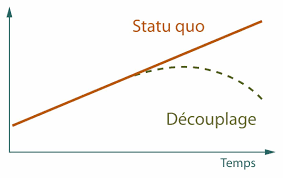
Strategies toward ambitious climate targets usually rely on the concept of ‘decoupling’; that is, they aim at promoting economic growth while reducing the use of natural resources and GHG emissions. GDP growth coinciding with absolute reductions in emissions or resource use is denoted as ‘absolute decoupling’, as opposed to ‘relative decoupling’, where resource use or emissions increase less so than does GDP. Based on the bibliometric mapping in part I (Wiedenhofer et al, 2020 Environ. Res. Lett. 15 063002), we synthesize the evidence emerging from the selected 835 peer-reviewed articles. We evaluate empirical studies of decoupling related to final/useful energy, exergy, use of material resources, as well as CO2 and total GHG emissions. We find that relative decoupling is frequent for material use as well as GHG and CO2 emissions but not for useful exergy, a quality-based measure of energy use. Primary energy can be decoupled from GDP largely to the extent to which the conversion of primary energy to useful exergy is improved. Examples of absolute long-term decoupling are rare, but recently some industrialized countries have decoupled GDP from both production- and, weaklier, consumption-based CO2 emissions. We analyze policies or strategies in the decoupling literature by classifying them into three groups: (1) Green growth, if sufficient reductions of resource use or emissions were deemed possible without altering the growth trajectory. (2) Degrowth, if reductions of resource use or emissions were given priority over GDP growth. (3) Others, e.g. if the role of energy for GDP growth was analyzed without reference to climate change mitigation. We conclude that large rapid absolute reductions of resource use and GHG emissions cannot be achieved through observed decoupling rates, hence decoupling needs to be complemented by sufficiency-oriented strategies and strict enforcement of absolute reduction targets. More research is needed on interdependencies between wellbeing, resources and emissions. [Lire plus]
Aller au contenu PDF